The “3D mesh” design of a memory foam pillow: breathable or just a formality?

From the perspective of usage scenarios: hot and humid nights and lingering heat
Imagine a typical summer night: the air conditioner is set to 25 degrees Celsius, yet the back of your head still feels hot under your pillow. Traditional memory foam pillows share a common trait: they offer good support but poor heat dissipation. The high density of the foam itself creates poor air flow, so once heat accumulates, it’s difficult to dissipate quickly. This is why adding a “3D mesh fabric” outer layer to memory foam pillows has become popular.
The principle of 3D mesh design: air layer or psychological comfort?
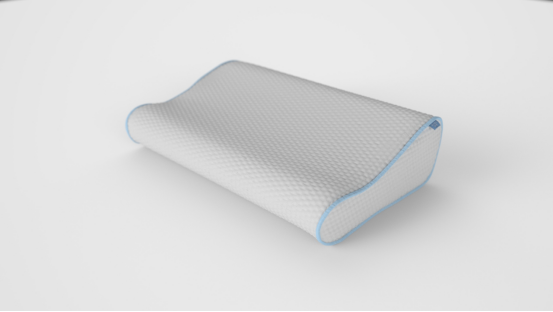
The so-called “3D mesh” generally refers to a three-dimensional, breathable fabric with gaps between the fibers, allowing air to circulate through the surface in a microscopic layer. In theory, this design is indeed more breathable than a pure cotton cover. This is especially true when you turn your head or move slightly, as the air is compressed and released, creating a certain circulation effect.
But the key point is this breathability occurs more on the surface of the pillow rather than penetrating deep into the core of the memory foam. In other words, the 3D mesh creates a “surface cooling” effect, but it doesn’t alter the foam’s inherent heat-retention properties. If you’re a heat-sensitive sleeper, you might still feel heat trapped in the pillow.
User feedback and experiment comparison: mixed reviews
On American sleep product forums, many users shared their personal experiences. One said, “I switched to a memory foam pillow with 3D mesh, so at least I don’t wake up drenched in sweat.” Others complained, “It feels cool at first, but after a while, I still feel hot.”
An independent testing organization conducted a simple comparative experiment: two pillows were placed in a constant-temperature room—one with regular memory foam and the other with 3D mesh. The results showed that within 30 minutes, the surface temperature of the mesh pillow dropped about 15% faster. However, after an hour, the internal temperatures of the two pillows were almost identical. This suggests that the 3D mesh is more effective at dissipating heat from the surface over short periods of time.
Advantages and limitations: Suitable for people with mild needs
If you’re not particularly sensitive to heat and only occasionally find your pillow a bit stuffy, the 3D mesh design can indeed offer some comfort improvements. It also has another advantage: it’s easier to clean. The mesh’s unique structure prevents sweat and sebum from completely penetrating the sponge core, and the breathable layer also extends the lifespan of the pillow.
But for people who are extremely afraid of heat and easily wake up at night, this design may not be enough. A more effective way may be to choose a memory foam pillow with a gel layer or simply consider a latex pillow, which is a more breathable material.
The marketing logic behind the design: differentiation or gimmick?
It’s undeniable that “3D mesh” is a selling point that consumers easily remember. Visually, it creates a more “technical” feel than ordinary fabric covers, a desired effect for the brand. You’ll notice that many pillow advertisements repeatedly emphasize “three-dimensional breathable mesh” and “circulating air layer,” but rarely mention the actual mesh thickness or breathability. This is something consumers should be wary of.
However, we can’t completely dismiss it. After all, even if it’s just a marketing gimmick, if it can bring some improvement in real-world experience, it still makes sense for users. However, it’s not a fundamental solution to the pillow heat dissipation problem.
Future trend: Multi-level heat dissipation is the answer
The industry trend is shifting toward “multi-cooling” designs. For example, some high-end memory foam pillows combine 3D mesh, gel particles, and perforation, allowing air to circulate not only on the surface but also through channels within the foam itself. This truly addresses the problem of nighttime overheating.
So, 3D mesh is not “useless,” but its value lies in small improvements rather than radical changes. It’s like adding a layer of screen to the car window, which allows you to feel the breeze but can’t block the scorching sun.
Summarize
The 3D mesh design on the Memory Foam Pillow does have some benefits, particularly in improving initial breathability and making it easier to clean. However, it’s not a cure-all solution, and its effectiveness is limited for those who are extremely sensitive to heat. If you’re considering buying a pillow, consider the 3D mesh feature as a bonus, not a deciding factor.
Would you spend a few dozen dollars more for a little bit of breathability improvement? Or would you rather invest in a truly multi-layer cooling pillow? This may be a question you need to seriously consider before purchasing.