Does the “gel layer” of a memory foam pillow really cool you down? Experimental data reveals

Imagine this:It’s a midsummer night, and within minutes of lying in bed, your pillow starts to heat up, as if the back of your head were resting on a warm stone. You toss and turn, but neither side of the pillow feels cool, and you finally turn up the air conditioner to its lowest setting. Consequently, memory foam pillows with a “gel layer” are being touted as a lifesaver, claiming they absorb heat and cool you down, allowing you to sleep cooler. But the question is—how much scientific evidence do these claims hold? Can gel really solve the problem of foam heating?
Why does a memory foam pillow get hot easily?
To understand the “cooling” gimmick, we need to first understand why memory foam accumulates heat. Foam’s most notable characteristic is its slow rebound, which molds to the curves of the head and neck for even support. However, this “fit” also restricts airflow. Unlike traditional cotton or down pillows, foam’s essentially closed-cell structure prevents heat from dissipating, leading to increased warmth the longer you sleep.
Some studies have shown that the surface temperature of ordinary memory foam pillows can rise by 2–3°C after 30 minutes of continuous contact. This can be a nightmare for those who sweat easily or live in tropical regions. As a result, manufacturers have introduced so-called “gel-infused” designs.
The principle of gel layer sounds reasonable
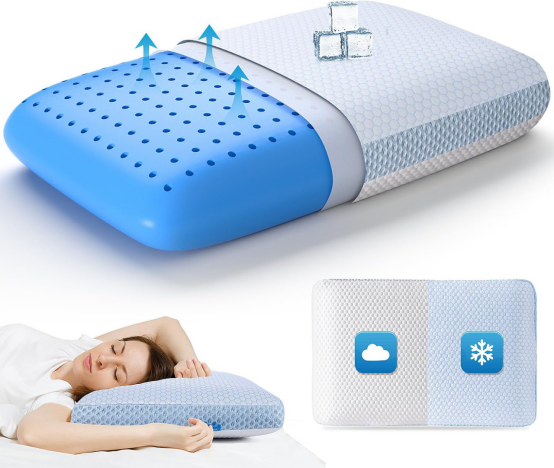
In theory, gel has a greater specific heat capacity than foam, meaning it can absorb more heat in a shorter period of time. When gel particles, a gel coating, or a whole gel layer are added to a memory foam pillow, it does initially feel cool, much like how your hand on tile is always cooler than on wood.
Many businesses like to describe it as a “phase change material”—when the temperature rises, the gel temporarily absorbs heat, slowing the temperature rise. This sounds very scientific, but the experimental data may not reveal the answer as advertised.
What do the experimental data say?
A study on pillow temperature regulation published in the Journal of Chiropractic Medicine showed that a memory foam pillow with a gel layer was indeed 1–1.5°C cooler than a regular foam pillow for the first 15 minutes. However, after an hour of use, the temperature difference gradually narrowed, eventually reaching a similar level. In other words, the gel’s “cooling” effect was more of a short-term buffer than an effective overnight cooling system.
Consumer feedback confirms this. In Amazon’s review section, many users report that while the pillow feels cool upon first lying down, they wake up in the middle of the night to find it still warm. Interestingly, some even find the gel layer makes the pillow a bit firmer, impacting overall comfort.
User Experience: Differences in Real Scenarios
Let me give you a personal example. My friend Mike lives in Texas, where summer nights often exceed 30°C. He specifically bought a so-called “cooling gel memory foam pillow.” His first week, he exclaimed, “Finally, I don’t have to change the pillow cover in the middle of the night.” But after a month, he said, “Honestly, I still have to rely on fans and air conditioning. The gel only helps me last an extra 20 minutes at most.”
Another user shared on the forum that her pillow features a “gel particle infusion” design, which is softer than a solid gel layer. She feels this design doesn’t affect the pillow’s flexibility, and the cooling sensation lasts longer. While it doesn’t completely solve the heating issue, it’s at least much better than before.
So, is the gel coat worth it?
It depends on your expectations. If you’re hoping for a pillow that keeps you cool all night, you might be disappointed. But if all you need is a pillow that doesn’t feel too hot before bed, a memory foam pillow with a gel layer can definitely help.
Some experts suggest considering the breathability of the pillow in conjunction with the overall bedding environment:
- Pillowcase material: Choose breathable cotton or bamboo fiber pillowcases to speed up heat dissipation.
- Room temperature: No amount of gel can beat a good air conditioning setting.
- Foam density: High-density foam has strong support but is more likely to accumulate heat; medium density may be more balanced in terms of comfort and breathability.
In other words, the gel layer isn’t a magic bullet, but it can be a helpful addition to your sleep routine.
Market trends: Manufacturers’ improvement directions
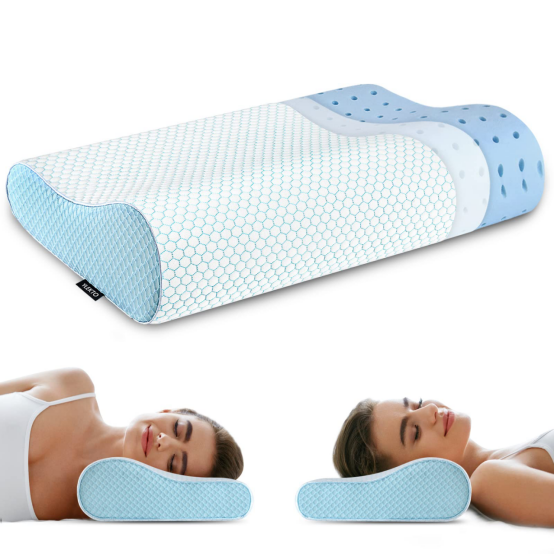
It’s worth noting that the market has begun to recognize the limitations of simply adding a gel layer. Some brands have introduced composite designs combining perforated ventilation with gel injection, even incorporating phase-change fiber pillowcases to prolong the cooling effect. Others are using 3D mesh jackets to enhance air circulation. These efforts demonstrate that the industry is continuously exploring solutions to the heat-trapping problem of foam, rather than relying solely on gel.
Data indicates that the North American cooling pillow market is expected to grow by over 12% by 2024, demonstrating continued consumer interest in cooling sleep technology. However, a growing number of consumers are adopting a more rational approach, moving beyond mere advertising sway and prioritizing individual use cases.
Summarize
While a memory foam pillow with a gel layer does provide a brief cooling sensation, it’s not a complete cooling solution. Experimental data shows that the cooling effect is most pronounced in the first hour, after which it gradually approaches that of a regular pillow. For those who are sensitive to heat, it provides a minor relief, not a complete solution.
If you’re considering buying one, consider the pillow’s overall design, such as the ventilation holes, the material of the pillowcase, and the sleeping environment. After all, truly cool sleep is the result of a combination of factors.
Do you think you really need a “gel pillow”? Or would you rather solve it through environmental adjustment? Feel free to share your thoughts in the comments section.