Recycling memory foam pillows: How to dispose of old pillows in an environmentally friendly way?

When that pillow can no longer hold your head up: The “second life” of the memory foam pillow
While tidying my bedroom , I noticed that my memory foam pillow, which I’d only used for four or five years, was already warping, wrinkling, and even slightly sagging at the edges. Thinking of the years of sleep history, hair marks, and embossed marks I still had on it, I suddenly realized: How long can a pillow really last? What’s its future?
So I began to research: After you’ve stopped expecting to sleep on it, is that memory foam still worth repurposing? Or, what other possibilities are there for its reuse? This article will explore the “recycling path” of memory foam pillows, from material mechanics, recycling challenges, feasible recycling routes, case studies, and practical advice.
Material nature and recycling difficulties: Why are memory foam pillows not easy to “sort and recycle”?
To talk about recycling, we must first understand the material properties and structural limitations of memory foam pillow.
Chemical properties of polyurethane sponges: cleavable vs. irreversible
Memory foam is mostly a thermoplastic polyurethane/polyurethane viscoelastic combination . Once formed and cross-linked, its structure is not as easily remelted and reconstituted at high temperatures as ordinary thermoplastics. In other words, once foamed and molded, it’s difficult to reconstitute the original polyurethane polymer. Earth911’s recycling guide explicitly states that memory foam is difficult to break down into its original plastic monomers and then reconstitute.
Therefore, the traditional route of “throwing it into a plastic recycling bin and handing it over to a recycling plant for dissolution and remaking” is basically not feasible for memory foam pillows.
Fragmentation/recycling of scraps is the mainstream path
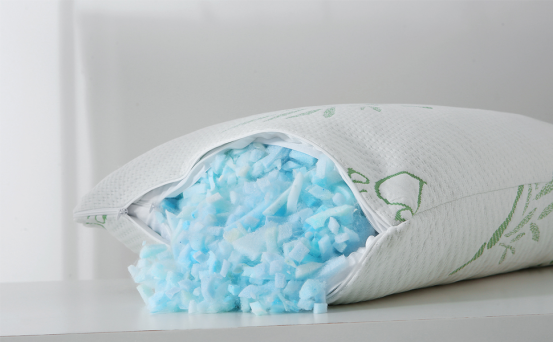
Although memory foam can’t be completely restored, it’s still possible to “crush/cut/tear” it into shredded foam. These shredded foam can then be stuffed, re-pressed, and used in secondary products like cushions, furniture fillings, car interior padding, or sound insulation. Earth911’s information mentions that memory foam can be shredded and used to make new foam products or car seat cushions.
However, this approach is difficult due to the high cost of disassembly, strict sorting and cleaning requirements, high transportation and handling fees, and insufficient market demand for “remanufactured products.” Consequently, many recyclers are reluctant to recycle small items (such as pillows).
Local policies/recycling systems are not yet perfect
In many countries and regions, mattress and pillow recycling primarily focuses on recyclable components like steel, metal, and wood frames, while the foam is often considered a difficult-to-dispose waste. Many recycling centers and recycle centers won’t accept whole memory foam pillows. Naturepedic’s recycling guidelines also note that pillows covered with polyurethane may not be accepted in standard textile or waste sorting channels.
Furthermore, even if there are recycling channels, sometimes they only accept large quantities of furniture/mattresses for recycling. Individual users or a small number of pillows may not be accepted or may require additional fees.
In summary: Recycling memory foam pillows is much more difficult than recycling ordinary textiles, but it’s not impossible. The key lies in “reusing scraps, donating/secondhand, and creatively transforming.”
Four possible disposal/reuse routes: Planning a future for your old pillows
Below I will give you several reference routes from three dimensions: practical operability, input cost and environmental protection effect.
Route 1: Donation/Second-hand transfer (while it still has value)
This is one of the cleanest ways. If your memory foam pillow is a bit old but still provides support and has no serious odor, mildew, or mud spots, you can consider donating or transferring it:
- Contact local charities, community centers, and shelters to ask if they accept pillow or bedding donations (be aware of their hygiene requirements).
- Post transfer information on second-hand bedding platforms (such as Facebook Marketplace, second-hand bedding forums, etc.).
- The prerequisite is that the pillow needs to be thoroughly cleaned and disinfected to ensure that it is free of dust mites, odors and stains.
Doing so has two benefits: extending the life of your memory foam pillow and reducing waste; and helping others. Nature Nest also recommends on its blog: If possible, prioritize whether to donate or resell it.
The disadvantages are: many donation organizations may refuse to accept pillows due to hygiene/logistics/management restrictions; the demand for used pillows in the second-hand market is also unstable.
Route 2: Shredding and Recycling/Material Recovery
If the pillow has been severely deformed and can no longer be used for sleeping, then the mainstream idea is to disassemble and crush it into reusable materials:
- Remove the pillowcase/fabric and recycle the fabric, zipper, label and other recyclable parts separately;
- Cut, chop and crush the memory foam core into small foam particles;
- These scraps can be used for filling (pillows, cushions, furniture cushions), acoustic sound absorbers, packaging filling materials, etc.
- If you can find a local foam/furniture recycling company, you can give them small quantities of scraps for remanufacturing or energy recovery.
However, please note that the shredding/recycling process requires clean sorting, dust removal, transportation costs, and a market for the re-products. Otherwise, even if you do “environmentally friendly dismantling”, the shredded materials may still end up being discarded.
Earth911 pointed out that while there is a potential market for memory foam recycling, many recycled foam products lack market competitiveness due to the low cost of virgin foam materials.
Route 3: Creative Reuse/Upcycling (DIY Renovation Ideas)
For those who are into handmade crafts, want to save costs, or pursue fun, this is the most likely route. Here are a few common ideas:
- Pet Bed/Pet Mat : Transform pillows into sleeping mats for cats and dogs, using shredded memory foam as the filling material.
- Floor mat/seat cushion/chair cushion : If thick enough, it can be transformed into a floor cushion, yoga mat base, etc.
- Packaging/cushioning materials : Shredded foam can be used as cushioning filler for moving/furniture/electrical appliances packaging.
- Door bottom draft strips : Stuff long strips of foam into the door gaps to make draft strips/floor gaps;
- Patchwork/Quilt Filling : Use shredded foam and fabric to make patchwork cushions or quilt filling.
- Pillow filling supplement : If you have other low-elasticity pillows, you can supplement their internal sagging areas as filling.
These paths are irregular and have a bit of a “home-made” feel, but that’s exactly where “old pillows can find a second life.” RecycleDevon lists a variety of practical and easy-to-use ways to reuse old pillows.
Route 4: Professional recycling/disposal (as a last resort)
If none of the above options are feasible (e.g., the pillow is severely damaged, cannot be disassembled, there are no local recycling options, etc.), then you may have to discard it or give it to a professional waste disposal agency. However, this can also be done in a more environmentally friendly way:
- Contact local recycling companies to ask if they have diversion channels for foam/waste bedding;
- When buying a new pillow, ask the merchant if they offer recycling/exchange services for old pillows;
- Disassemble the items before disposal (remove recyclable fabrics, metal/labels, zippers, etc.) to reduce the volume of contamination;
- Try to avoid mixing the entire memory foam pillow into regular combustible trash to reduce unnecessary landfill burden.
Some delivery/disassembly services under large furniture/home recycling items will handle foam parts during recycling.
Practical Tips: How to Dispose of Old Pillows in a More Environmentally Friendly Way?
The following “practical suggestions” are summarized from industry experience and user feedback. I hope they will help you avoid pitfalls when you are dealing with them.
- Thoroughly clean/disinfect first : remove scalp oil, sweat, mites, reduce odor and hygiene risks;
- Disassembly order is from outside to inside : first remove the pillowcase/quilt cover/fabric and fasteners, then deal with the foam core;
- Wear a mask/dust-proof measures when cutting/shredding : Foam cutting easily produces fine powder;
- Try it on a small scale : If you plan to DIY or remodel, start with a small sample and then expand;
- Recording and labeling : If you remove multiple types of materials (cloth, foam, plastic), label them to facilitate subsequent sorting;
- Find local resources : Many cities/communities have textile/furniture/waste recycling centers, so call first to inquire;
- Stay safe/comply with the rules : comply with local garbage disposal regulations and do not litter without permission;
Inspiration and future trends: The green future of memory foam
- Material innovation direction : Degradable/bio-based memory foam materials may appear in the future, allowing the memory foam pillow to be partially biodegraded at the end of its life, rather than just being shredded and reused.
- Closed-loop design/recyclable design : The “disassembly/recyclability” structure is considered during the product development stage, making the pillow easier to disassemble, sort, and recycle.
- Construction of a recycling industry chain : More furniture/bedding brands, recyclers, and remanufacturers need to work together to establish a dedicated recycling and regeneration system for memory foam pillows.
- Improved user environmental awareness : Brands can provide old pillow recycling services and encourage users to participate in “old pillow replacement/donation programs”, so that “disposal” is no longer a passive task at the end.
Don’t let your memory foam pillow become “silent garbage”
- Although memory foam pillows are difficult to fully recycle like plastics, there are still many ways to recycle them, such as scrap recycling, donation/second-hand transfer, and creative transformation.
- Choosing the right route and operating in steps can minimize the environmental burden;
- If you want to know our brand’s policies or plans on “recycling/replacing/second-hand disposal of old pillows”, I can also write a special article for you on “Environmental Responsibility/Sustainable Development”.
memory foam pillows designed with recyclable structures or detachable materials HYPERLINK “https://salememoryfoampillow.com/pillows/” , which may become your next environmentally friendly sleeping choice.