The “edge support” design of memory foam pillows: Why do some pillows not collapse at the edges?

Fold a standard-sized memory foam pillow into a U-shape, apply pressure to the edges, and then release it to observe its recovery. Some pillows’ edges quickly rebounded, standing as strong as new; others, however, bent slightly at the corners, even slightly pinching hair.
This phenomenon is not just an intuitive judgment of “whether it is a good pillow”, but also related to the user experience: the non-collapsed edge means that the support area for the head, neck and shoulders is larger and more stable. Especially when people sleep close to the pillow, half on the pillow and half on the bed, this support difference is particularly obvious.
So, what makes some memory foam pillows so durable? This article will examine structural design, material formulation, density zoning, user needs, and manufacturing trends. Hopefully, this will help you more consciously assess the benefits of edge support when choosing a pillow next time.
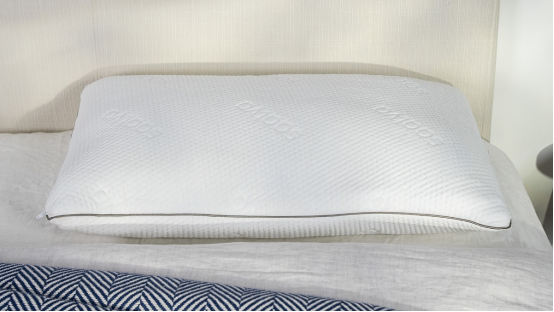
Edge support does not collapse: What factors are at play?
In order to prevent the edge of the pillow from collapsing, designers and engineers usually work hard in the following aspects:
1. Density/hardness gradient differentiated design
The overall density and firmness of a memory foam pillow fundamentally influence its elasticity, deformation, and support capabilities. If the pillow’s edges are made of a slightly higher-density/harder material (or if the edges are thickened or reinforced), the edges will be less likely to permanently deform under pressure.
This “edge density reinforcement” strategy is somewhat similar to the “edge reinforcement” design used in mattresses. Many mattress brands use reinforced foam or steel rings around the outside to prevent edge collapse. A similar approach can be applied to pillow design: a soft center and slightly firmer edges create a comfortable fit and stability.
2. Partition/Layered Structure + Support Framework
More advanced memory foam pillows may feature a layered or zoned structure . For example, the core may be standard memory foam, while the middle or outer layer may be high-resilience foam, a grid structure, a honeycomb structure, or reinforced ribs to support the edges.
For example, some designs create a “frame” or “channel” shape around the edge of the pillow, with semi-rigid material or thickened ribs embedded in the outer ring to support the edge and prevent it from bending. This structure is sometimes called an “edge support frame” or “support ring.”
Another possibility is that the pillow core is made of a double-layer structure: the outer layer is slightly harder for protection, and the inner layer is slightly softer for a better fit. This way, the edges will not collapse easily due to the soft material alone.
3. Elastic recovery performance/rebound speed (fast rebound + elastic material)
Edge support also relies on the material’s resilience . If the pillow core uses a high-rebound material or incorporates elastic components (such as cross-linked polymers, elastic fiber blends, or composite foam) around the edges, the edges will recover more quickly after being compressed, preventing them from retaining their original shape.
In other words, if the edge material is too loose and slow to rebound, it will tend to “yield” a little under pressure; if the edge is made of a more elastic material, it will act like a spring and bounce back quickly when pressed.
4. Geometric Effects of Size/Shape/Thickness Design
Edge support is also related to geometric design . For example:
- If the edge of the pillow itself is made thicker (with a certain amount of height), the edge will have a greater “leverage” advantage and will not easily break off.
- If the pillow has curved ends, cuffs, or three-dimensional edging designs, these shapes will increase structural rigidity.
- The overall height difference and contour changes of the pillow may also affect the force transmission at the edges: if the edges have a slight arc or bevel design, the pressure may be directed back to the core instead of being concentrated at a certain point in the corner.
5. Durability and anti-fatigue design
A pillow might have excellent edge support when it’s first purchased, but over the years, as the foam fatigues and loosens, the edges may gradually lose their support. Therefore, memory foam pillows that have anti-fatigue modifiers (such as cross-linking agents, reinforcing fibers, and anti-deformation additives) added to their formula are more likely to maintain their edges during long-term use.
In other words, the edge support design must not only be able to stand up, but also “last long”.
Why is edge support important? User experience and scenario investigation
To understand what this “edge support” has to do with ordinary users, the following scenarios or comparisons may give you a better sense of immersion.
Sleeping close to the pillow/risk of head “sliding to the side” when turning over
Many people tend to move their heads towards the edge of the pillow when they sleep—perhaps because they toss and turn, their bedding squeezes them, or simply because they’re leaning inward. If the edge of the pillow collapses, your head will feel like it’s falling or lacking support when it approaches the edge, leaving your neck and shoulders in an unnatural “dangling” position. A non-slumping edge ensures reliable support even when you’re close to the edge.
Armrest/Pillow Sleeping Stability
Some people like to support themselves with their arms on the edge of their pillow (for example, when sleeping on their stomach or side). If the edge of the pillow is prone to collapse, the pressure from their arms can cause it to collapse, causing the pillow to lose its original shape. Good edge support can enhance the pillow’s “load-bearing margin,” preventing you from being “slapped” in these unconventional positions.
Tolerance of overall pillow deformation
Edge support can significantly slow the spread of fatigue deformation throughout the pillow. If a corner collapses, it can cause the center to deform. Conversely, if the edges are stable, even if the center is deformed, the overall pillow shape remains more resilient.
A small experiment: edge stress testing and rebound observation
To verify the above theory, I did a small experiment (home use):
- Prepare two memory foam pillows (A and B) of different brands. A claims to have an edge support design, while B is a regular homogeneous foam design.
- I pressed down on the edges of their long sides with my hands with a fixed force of 5kg, held for 10 seconds, then released my hands and observed their recovery.
- Result: The edge of A has almost completely recovered to its original shape, with only slight indentations; the edge of B has a clear curvature, and the edge is still slightly bent.
- Then I placed a 1 kg weight near the edge for 5 minutes. A was still able to basically maintain its height, while B sank slightly and deformed.
This simple self-test proves that memory foam pillows with edge support design, structural reinforcement, or high-rebound materials are less likely to collapse at the edges and are indeed more stable than ordinary homogeneous pillows.
(For reference only, self-test results are also affected by temperature, humidity, foam batch, etc.)
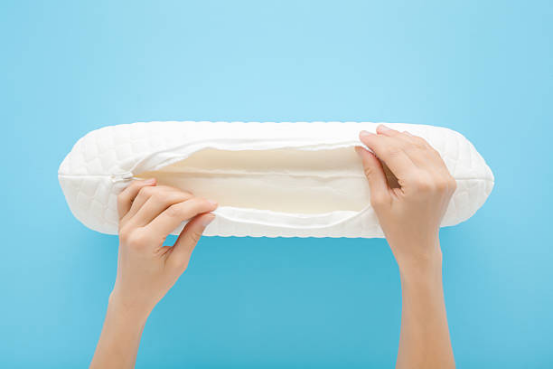
How to judge the “quality of edge support” when purchasing?
The following judgment points can help you predict and compare the “edge support” ability when choosing a memory foam pillow.
See product description/design selling points
- Check whether there are terms such as “edge support / edge support / reinforced edge / support frame / support ring / perimeter support”.
- Check the pillow core structure description: whether it mentions “partitions/double layers/frame structure/reinforced ribs/frame”.
- Some manufacturers will provide edge load-bearing test data or stress test recovery diagrams in their instructions.
See the actual stress test / rebound test
- After receiving the product, you can press various edges of the pillow (long sides, short sides, corners) and observe the recovery time and degree.
- Apply slight pressure for a short period of time (e.g. 30 seconds, 1 minute) to see if there is any obvious residual deformation.
- If possible, you can also refer to user reviews or disassembly diagrams (if there are mold opening/cross-section diagrams) to observe the internal structure of the edge.
Look at density/material/added ingredients
- The higher density and deformation-resistant memory foam material is reinforced at the edges to provide more basic protection.
- If supporting fibers/elasticity enhancers/cross-linked structures/carbon fibers/conductive fibers are incorporated into the edge area material, it is possible to achieve both rigidity and elasticity.
- Be careful not to confuse “extremely hard” with “strong edge support”, as excessive hardness may also sacrifice comfort.
See pillowcase/edge/contour design
- Some pillows have reinforced stitching, edging tape, and three-dimensional hem designs on the pillowcase or edge to enhance the border structure.
- Some designs have the edges of the pillow slightly turned up to create a “brim” structure to help with support.
- If the pillow corners are designed with right angles, hemming seams, decorative bands, etc., it may have both decorative and structural support functions.
Design Trends and Future Directions: Edge Support Is More Than Just an “Added Value”
As users have higher and higher requirements for high-quality sleeping experience, there have been some significant trends in the edge support design of memory foam pillows.
- hybrid materials + zoned structures
is to use soft, conformable foam in the core, while using more elastic or high-rebound materials on the edges, or even embedding lightweight frames or ribs. This can maintain flexibility while improving edge stability. - Modular/Adjustable Frame Design:
Some manufacturers are developing detachable frame/support ring designs, allowing users to decide whether to install edge supports based on their preferences. This is more user-friendly for users with different preferences. - The bionic/honeycomb/frame skeleton
draws on the design of honeycomb structure, three-dimensional grid and micro-skeleton to enhance the edge strength through geometric configuration without appearing heavy. - Long-term anti-fatigue/material durability upgrade:
Anti-fatigue agents, cross-linking agents, fiber reinforcement structures, conductive or anti-fatigue fibers, etc. are added to the formula to ensure that the edge support does not decay after years of use. - AI-driven design optimization/digital simulation modeling
High-end manufacturers may use simulation modeling tools (finite element analysis, structural simulation) to optimize edge geometry, material distribution and stress path to achieve the goal of preventing edge collapse while maintaining lightweight.
Edge support is the key to making a memory pillow durable.
The fact that the edges do not collapse is not a decorative gimmick, but rather a matter of the “reliability” and “durability” of a pillow in real-world use:
- The strong edge support allows you to get stable support when you are close to the pillow, turning over, leaning on your arms, or sleeping half-way;
- Structural reinforcement + high-elastic materials + partition design are the three main paths to achieve this goal;
- When purchasing, comparing the instructions, physical pressure test, and structural design judgment points is an essential way to pick a good pillow.
- Judging from the trend, mixed materials, frame skeletons, modular supports, bionic structures, etc. may become the mainstream of edge design in the future.
The key to a good pillow lies in the details. Whether the edges collapse is not just a matter of comfort; it also reflects the expertise of the structural design . Our memory foam pillow series achieves independent load-bearing at the center and edges, maintaining a stable shape over time.