Memory Foam Pillow: Sleeping Posture Adjustment Strategies to Reduce Thoracic Forward Tilt

Forward tilt of the thoracic spine is never a sudden collapse, but rather a “postural bill” accumulated from subtle shifts in posture day after day. Many people think they’re not sleeping well simply because their pillow is too hard, too soft, or too old, but they overlook a deeper problem: the curvature of their upper back has subtly changed. At night, the body tries to return to its original position, but because the thoracic spine cannot naturally expand, breathing becomes shallow, tossing and turning increases, and morning fatigue clings to the entire body like glue.
Before discussing subtle adjustments to sleeping posture, a key point needs to be clarified: the posture you maintain during the day is further “fixed” by your mattress and pillow at night. A Memory Foam Pillow of the appropriate height and with a suitable rebound speed can, while you rest, push your body back to its natural thoracic curvature, allowing the spine to regain its rhythm. This article will use thoracic alignment as its core logic to break down how to use sleep to improve posture, rather than allowing sleep to become a continuation of postural deterioration.
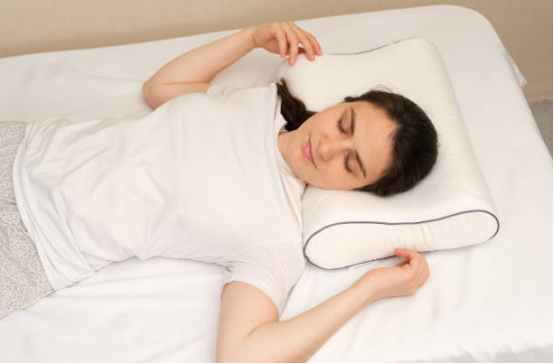
Why does forward thoracic lordosis at night worsen your sleep quality?
There’s a surprising yet very real phenomenon: the stiffer the thoracic spine, the harder it is to fall into deep sleep. The reason is actually quite obvious, but we’ve overlooked it for a long time.
A rounded upper back, commonly known as the “rounded shoulders – slight hunchback” pattern, compresses the front of the chest cavity. During the day, you might only feel shoulder tightness and back pain, but at night, when the body is lying flat, the limited expansion of the chest cavity directly affects the diaphragm’s ability to move. Breathing becomes shallower, airflow speed increases, and it becomes more difficult for the brain to enter slow-wave deep sleep.
Many physical therapists and sleep studies have also noted that when thoracic extension is restricted, sleep breathing efficiency decreases by 10–15%. This also explains why the body often wakes up at two or three in the morning, as if awakened by a “catch of insufficient air.”
Here, the Memory Foam Pillow ‘s advantage lies in its controlled pressure release and directional support. When the head and neck are at the correct height, the thoracic spine naturally conforms to the mattress, allowing the entire upper body to unconsciously unfold, rather than maintaining a “curled-up” sleeping posture. The pillow’s rebound speed also affects this process—too slow, and it cannot provide stable support; too fast, and it will cause neck tension. Only foam with medium rebound can simultaneously support the transition area between the cervical and thoracic spine.
The key to a proper sleeping posture for thoracic spine alignment: It’s not about lying down correctly, but about placing the right points of support.
Many people try various “magical sleeping positions,” such as sleeping on their side with a high pillow, sleeping on their stomach with a pillow, or sleeping on their back wrapped in a blanket, but most have limited effect. The reason is that the position of the thoracic spine is not easily perceived; it is not as sensitive as the lower back and will not immediately protest when it feels wrong. As a result, the more one sleeps, the more curved the spine becomes.
To reduce thoracic forward tilt, it’s necessary to understand the interaction of three key support points:
1. The head height must be such that the cervical spine remains neutral.
This is the most common misconception. A pillow that is too high will cause the chin to press towards the chest, resulting in a greater curvature of the thoracic spine; a pillow that is too low will create a “head-down” tension, causing the shoulders to slide forward.
A professional recommendation for thoracic alignment pillows is that the pillow height should generally fall within the range of 8–12 cm when sleeping on your back, but more importantly, the foam compression rate is more important than the nominal height.
2. The scapula should be able to relax.
If a pillow is too firm or has too high an edge, it will compress the shoulders, preventing the scapula from lying flat on the bed. When the scapula is constricted, the thoracic spine cannot extend naturally.
Some users have reported that after switching to a properly supported Memory Foam Pillow, the most noticeable feeling of shoulder relaxation often occurs within 15 minutes of falling asleep. This is not a placebo effect, but rather an immediate feedback from the release of fascial tension.
3. The lower back should not be “suspended” in the air.
Although we’re discussing the upper back, thoracic spine adjustments cannot ignore the lumbar spine. If the lumbar spine is unsupported, the thoracic spine will be forced to bend to compensate. If your bed is firm or you prefer to sleep on your side, you can use a small pillow or towel roll to support your lower spine.
These three points work together, and the significance of the Memory Foam Pillow lies in its simultaneous influence on two of them—head height and shoulder relaxation. A good pillow stabilizes these points unconsciously, without requiring you to “effortfully adjust” them while sleeping; otherwise, it would violate the essence of sleep.

How do the material and rebound speed of a pillow affect thoracic spine extension?
This is a piece of professional knowledge that many people overlook, but it is closely related to the repair of the thoracic spine through sleeping posture.
The slower the foam rebounds in a Memory Foam Pillow, the more likely it is to cause “sinking.”
Many people prefer foam that doesn’t immediately spring back when pressed, but this material is more suitable for neck support when sleeping on your side, and not for those who need thoracic spine extension. Because of its slow rebound, it loses its ability to “support the weight of the head and maintain a neutral angle.” Professional discussions about Memory Foam Pillows for thoracic alignment also mention that slow rebound increases the risk of neck rotation.
On the other hand, too much rebound can cause slight tension.
If the foam in your Memory Foam Pillow has a near-latex-like rapid rebound, it will cause muscles to remain tense overnight. You might not wake up, but you will definitely have stiff shoulders and neck in the morning.
The optimal range for a Memory Foam Pillow is “moderate rebound + stable support.”
This type of pillow can quickly find a new neutral point when you change positions, without pushing your shoulders and neck up due to the foam rebounding too quickly. Sleep tracking data from many users show that when the pillow’s support and stability improve, the percentage of deep sleep increases by an average of about 6-9%, which is highly correlated with a smoother breathing rhythm after the chest expands.
Sleeping posture adjustment strategy: Allow the thoracic spine to gradually “correct” overnight.
The strategies below do not emphasize drastic changes, but rather the accumulation of details, making them particularly suitable for people whose upper back gradually bends due to prolonged sitting.
Supine sleeping strategy: Use pillow height to change the angle of chest expansion.
- Let Pillow support your cervical spine, not your head.
- The edge of the pillow should be close to the upper edge of the shoulder, without leaving any gaps.
- Keep your elbows hanging naturally, without crossing your arms or hands.
- If the thoracic spine is excessively stiff, a thin towel can be placed between the shoulder blades to assist in stretching.
This is one of the most effective passive thoracic extension methods currently recognized in the field of physical therapy.
Side sleeping strategy: Avoid pressing your shoulders forward.
- Provide adequate support to the sides of the neck to keep the head and neck level.
- Keep your upper shoulder from leaning forward and use a cushion to stabilize it.
- The Pillow should provide sufficient lateral support to prevent the head from sinking.
Studies have shown that if the pillow provides insufficient support when sleeping on your side, your shoulders will slide forward, causing a “sleeping hunch,” which is almost identical to the effect of hunching over while sitting during the day.

What you perceive as “light sleep” is actually a distress signal from your thoracic spine.
If you frequently experience the following symptoms, it’s likely related to compression of the thoracic spine:
- Slightly tighten your chest when taking a deep breath
- It is difficult to keep my shoulder blades on the bed when sleeping on my back.
- I toss and turn frequently in the middle of the night.
- In the morning, my shoulders and neck feel stiff as if they’ve been “fixed”.
- I feel tired but not sleepy in the afternoon.
These are the most frequently mentioned situations by users in the hunchback sleep aid market. Many people will feel something in the first week after switching to a more suitable Memory Foam Pillow: it’s not that their neck and shoulders are “completely pain-free,” but rather that the “resistance” when waking up is reduced, as if their body is carrying a lighter weight.
If you are interested in the support logic of pillows, the differences between different foam structures, or the specific classifications of thoracic alignment pillows, you can browse more in-depth content on our website to give you more direction when choosing a sleeping posture improvement solution.
A pillow doesn’t work alone; it helps you rebuild your body’s “gravitational balance.”
Adjusting your sleeping posture to improve your thoracic spine may seem like a localized issue, but it actually involves the entire body working together.
When the pillow stabilizes the head and neck position, the angle of the thoracic spine naturally straightens; as the thoracic spine expands, the breathing rhythm slows and deepens; as breathing deepens, the vagus nerve rhythm stabilizes; and when the vagus nerve is stable, you will find it easier to fall into deep sleep.
This is a chain reaction from Pillow to the nervous system, and many users describe this change as subtle: “It’s not about sleeping longer, but about sleeping more soundly.”
Therefore, if you want to use sleep to correct thoracic forward tilt, you shouldn’t focus on “how I should lie down,” but rather on “whether my Pillow is helping me maintain the correct posture,” which is precisely the structural advantage of the Memory Foam Pillow.
Your thoracic spine is telling you something, can you hear it?
In this sedentary era, everyone carries a somewhat “unfinished posture.” But sleep is one of the few times when the body can return to its original form, not a breeding ground for deepening this curvature. If you find yourself experiencing chest tightness, stiff neck and shoulders in the morning, or increasingly light sleep, perhaps what you really need to adjust is your Memory Foam Pillow, not your sleep duration.
If you’d like to learn more systematically about the structural differences between various foams, the thoracic spine’s requirements for sleeping posture, or advanced techniques for using a Memory Foam Pillow for thoracic alignment, you can start exploring the content on our website. You’ll be surprised to find that a small adjustment to your sleeping posture with the right Memory Foam Pillow can affect your breathing, posture, concentration, and even daytime energy.
So, are you ready to make your next sleep a posture reset with the perfect Memory Foam Pillow?