The Memory Foam Pillow provides a more precise fit for people with broad shoulders.

memory foam pillow—takesWaking up in the morning with stiff shoulders and neck, as if they’ve been compressed, is a common occurrence for many people with broad shoulders. Many assume it’s due to a pillow that’s too high or too low, or that changing sleeping position will solve the problem, but the true structural causes are often overlooked. The unique acromion height, shoulder girth width, and shoulder sagging when sleeping on one’s side often lead to misaligned sleeping positions, which ordinary pillows can hardly address. Therefore, a seemingly simple sleep tool—the Memory Foam Pillow—takes on a deeper function: providing a custom contour foam support that closely conforms to the body’s structure, allowing people with broad shoulders to achieve their own unique sleeping posture geometry.
fit andBelow, we will analyze the logic behind the sleeping posture misalignment of people with broad shoulders from three perspectives: anatomy, materials engineering, and user experience. We will also explain why the Memory Foam Pillow stands out in the field of broad shoulder pillow fit, and how it helps users establish a truly stable cervical spine angle through sinking depth and soft gradient.
Sleeping Posture Misalignment Mechanism in People with Broad Shoulders
Even on an extremely soft mattress, people with broad shoulders still face a significant challenge when sleeping on their side: the lateral height of their shoulders is much greater than that of average body types. This height difference creates a tilt angle between the shoulder joint and the cervical spine, which in turn affects the midline position of the head.
You may have experienced something like this:
- The head was forced to tilt slightly to the side, unconsciously pressing against the chest.
- The neck muscles are stretched continuously at night.
- Waking up felt like surviving a silent “tug-of-war” at night.
These are not issues with sleeping posture, but rather postural deviations caused by structural mismatch.
People with broad shoulders need a pillow that provides greater “space displacement compensation” when sleeping on their side. In other words, the Memory Foam Pillow not only needs to support the head but also needs to absorb pressure on the shoulders and maintain the cervical spine in a neutral position. However, ordinary pillows are often designed for a general body type, leading to typical misalignment when used by people with broad shoulders:
- Insufficient pillow surface depression and discontinuous support
- Insufficient height, causing the head to naturally tilt to the side
- Unstable neck-shoulder angle
- Muscle compensation at night leads to increased stiffness in the morning
All of this constitutes the core problem of broad shoulder pillow fit: most pillow shapes cannot cope with the differences in force distribution from the broad shoulder width. The Memory Foam Pillow excels at addressing these issues by offering customized support that adapts to the unique contours of the body, providing a more stable and aligned sleep posture.
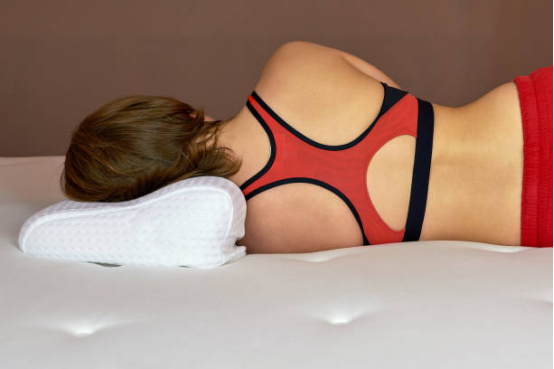
The sinking depth of the memory foam pillow is matched with the shoulder geometry.
When we talk about the Memory Foam Pillow, the real highlight isn’t its “softness” or “fluffiness,” but rather its pressure response performance—a microstructure tuning capability based on the material’s memory rebound.
People with broad shoulders experience greater vertical pressure on their shoulders when sleeping on their side. The memory foam’s sinking depth can precisely capture this pressure and create “isobaric deformation,” allowing the shoulders to sink to a depth that matches the body shape and enabling the cervical spine to naturally settle into the correct position.
This settlement is not a simple “sinking,” but a controllable spatial reshaping that is tailored to a customized fit:
1. The depth of subsidence determines the amount of subsidence in the shoulder area.
Wider shoulders mean a larger contact area, and the material in the memory foam pillow can sink in sections according to the pressure. The shoulders are heavier, the head is more stable, and there is a smooth transition between the two, avoiding the discontinuous feeling of “the shoulders being stuck.”
2. Gentle gradient shaping for a smooth transition between the neck and shoulders.
A professional custom contour foam structure typically creates areas of varying density within the pillow surface, for example:
- Softer shoulder area
- Slightly stiff neck
- Moderately supported head position
This gentle gradient allows the neck to remain in a neutral position without overbending or overextending due to shoulder width.
3. Lateral support strengthens the cervical midline
The biggest concern when sleeping on your side is that the head may shift horizontally due to the “lifting” of your shoulders. The memory foam pillow forms a natural lateral support band after settling in, guiding the head back to the midline position. This subtle but crucial angle correction is the core of a comfortable experience for those with broad shoulders.
Anatomical Perspective: Why People with Broad Shoulders Need Custom Contour Foam More
From an anatomical perspective, the problem people with broad shoulders encounter during sleep is not a typical “comfort issue,” but rather a “space mismatch issue” caused by structural differences in acromion height, clavicle width, and the neck-shoulder junction.
Acromion height affects the midline of the head
People with broad shoulders have a higher acromion height, and if the pillow is not high enough when sleeping on their side, the cervical spine will adopt a “lateral tilt” angle. Long-term muscle compensation includes:
- Excessive tension in the levator shoulder muscles
- The sternocleidomastoid muscle is under continuous traction at night
- Slight accumulation of cervical scoliosis
This ultimately creates a series of hidden pressures that are only felt after waking up. The Memory Foam Pillow addresses this by adjusting its support to the unique height and angle of the acromion, helping to maintain proper cervical alignment during sleep.
The width of the clavicle affects the contact point of the pillow surface
A wide collarbone creates a unique angle at which the pillow contacts the body. Ordinary pillows cannot provide a matching curve for this angle, resulting in discontinuous support distribution. The Memory Foam Pillow, with its ability to mold to the shape of the body, compensates for this by adjusting to the specific contours of the clavicle, providing consistent support across the shoulder area.
The significance of custom contour foam lies in its ability to reshape the pillow’s surface curve through pressure, allowing the Memory Foam Pillow to “learn” the logic of your shoulders. By adapting to the structural variations of broad shoulders, it ensures a more comfortable and supportive sleep posture that prevents misalignment and promotes better spinal health.
The neck-shoulder angle determines the settlement requirement.
People with broad shoulders have a more defined shoulder-neck angle, which means:
- The pillow needs to provide deeper shoulder sinking.
- The neck needs more defined support.
- The head contact point must form a natural support.
The memory foam pillow possesses this flexibility of “adapting to the structure rather than forcing it.”

Why does the memory foam pillow make a noticeable difference for people with broad shoulders?
Similar descriptions have appeared in many real feedback reports:
- “For the first time, I felt that the pillow followed my contours, rather than making me adapt to it.”
- “When I sleep on my side, my shoulders feel like they’re being released and no longer compressed.”
- “The position of my cervical spine seems to have been automatically corrected.”
Why are these experiences so common?
1. Smoother shoulder positioning for side sleeping
When sleeping on their side, users with broad shoulders no longer have their shoulders pressing against the edge of the pillow but instead naturally sink into the pillow structure. This allows for a more even weight distribution across the head, neck, and shoulders.
2. Muscles no longer compensate at night.
When the support is natural enough, the neck doesn’t need to “struggle to align” as it used to, allowing the muscles to relax and significantly reducing stiffness in the morning.
3. No longer loses support when turning over.
The memory foam’s rebound speed is not rapid, but it is stable enough, which allows users with broad shoulders to maintain linear support for their cervical spine when turning over, without the embarrassment of “sinking into it and not being able to get out in the middle of the night.”
4. Smoother transitions between sleeping positions
Whether you sleep on your back, side, or slightly on your side, the core principle of the broad shoulder pillow fit is to maintain consistent support, allowing for a freer sleep process.
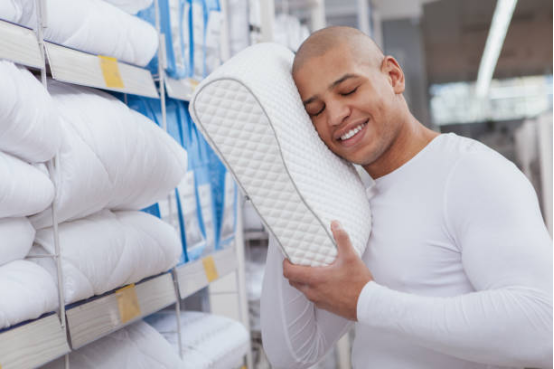
A path to finding a sleeping position tailored for people with broad shoulders
If we break down the sleep needs of people with broad shoulders into a single project, then the memory foam pillow acts as a “geometric corrector,” and its core value lies in:
- Use settlement depth to compensate for shoulder height
- Use a soft gradient to calibrate the neck and shoulder angle.
- Maintain the centerline position using the rebound logic of custom contour foam.
- The complex pressure distribution generated by the wide shoulders is supported by a complete curved structure.
This is not simply a matter of “soft” and “hard,” but rather a specific strategy tailored to the structural differences in the body of people with broad shoulders.
Broad shoulders are not a burden; they just require more precise support.
People with broad shoulders really need a “fit” when they sleep. The Memory Foam Pillow, within the broad shoulder pillow fit system, does not provide some abstract softness but rather a quantifiable, zoned, and automatically responsive spatial shaping ability.
More about the memory foam pillow sleep experience.