Potential auxiliary effects of memory foam pillows on people dependent on sleep aids

Many people do not truly “need” sleep aids at the beginning. In the early stages, it may be nothing more than a few nights of tossing and turning, leading to fatigue the next day. Over time, this turns into occasional “transitional” reliance on pills; later still, the absence of something taken before bed can itself trigger anxiety and heightened alertness. In this progression, the memory foam pillow rarely enters the conversation early on, even though physical support is already playing a quiet role in how easily the body settles at night. The core issue is that once the body becomes accustomed to chemical signals to initiate sleep, what ultimately hinders falling asleep is often not just the brain, but the entire body system’s growing unfamiliarity with genuine relaxation.
In discussions about sleep dependence, environmental factors are frequently underestimated. Light, temperature, and sound are mentioned repeatedly, yet few people seriously evaluate whether the body is actually comfortable enough in bed to fall asleep on its own. Subtle discomfort from inadequate head, neck, or shoulder support can keep the nervous system on low-level alert throughout the night. In this context, the role of a memory foam pillow becomes more relevant—not as a cure, but as a way to reduce constant micro-stimulation that prevents the body from fully letting go.
This is precisely why the memory foam pillow has gradually entered clinical and lifestyle discussions—not as a substitute for medication, but as a physical aid that may help rebuild a basic sense of safety and stability during sleep. By offering consistent contour support and minimizing pressure-related signals, it can support the body in relearning how to relax naturally, allowing sleep to emerge from comfort rather than chemical prompting.
Behind the use of sleep aids often lies an overlooked physical problem.
From a medical perspective, common sleep aids primarily work by affecting neurotransmitters in the central nervous system, making the brain more susceptible to inhibition. While they are indeed effective in the short term, long-term users often report several similar experiences:
I’m asleep, but sleeping lightly.
I often wake up in the middle of the night, and it’s even harder to fall back asleep afterward.
I felt lingering drowsiness in the morning.
These experiences are not entirely due to the side effects of the medication itself but rather a deeper, persistent problem: the body is not truly in a relaxed state but has instead been “muted.”
In particular, improper support for the shoulders, neck, upper back, and head can send weak but persistent discomfort signals to the nervous system throughout the night. When pillow structure fails to adapt to natural spinal curvature—something a well-designed memory foam pillow is specifically intended to address—these signals may not be noticeable during the day but are amplified in the quiet of the night. Even subtle misalignment, such as insufficient cervical support from a pillow that is too soft or unevenly compressed, can prevent the nervous system from fully downshifting into deep rest.
In this state, many people mistakenly believe, “I have insomnia again,” instead of realizing that posture and support are subtly interfering with sleep. Clinical observations show that optimizing head and neck positioning, often through adjusting bedding systems or switching to a memory foam pillow with consistent contour support, can significantly reduce nocturnal micro-arousals without pharmacological intervention.
This is why doctors in some rehabilitation medicine and sleep clinics recommend starting with non-pharmacological interventions, including adjustments to sleeping posture, bedding, and pillow structure. From this perspective, tools such as a properly matched memory foam pillow are not comfort accessories, but biomechanical interfaces that help reduce unnecessary neural alert signals, allowing the body to relax naturally rather than relying solely on chemical suppression.
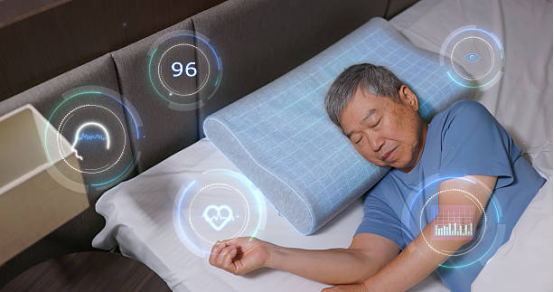
What’s missing between “relying on medication to sleep” and “being able to sleep naturally”?
For people who rely on sleep aids long-term, the real challenge is often not the withdrawal process itself, but the deeply ingrained psychological expectation that they “can’t sleep without medication.” In many cases, this belief has a tangible physical foundation: as soon as they lie down, discomfort appears. This is also where a memory foam pillow frequently becomes relevant, as it addresses the physical unease that reinforces that expectation rather than attempting to counter it chemically.
When the head, neck, and upper back are not properly supported, the body instinctively shifts into a state of alertness. Even if the conscious mind feels exhausted, the nervous system remains active, scanning for imbalance or strain. Under these conditions, medication becomes the fastest and most familiar solution, not because it resolves the underlying issue, but because it suppresses the body’s warning signals.
The role of a memory foam pillow lies precisely here: it does not attempt to “create sleepiness,” but instead aims to reduce unwanted interference signals by conforming more closely to the natural curves of the human body. By improving biomechanical alignment, it helps remove one of the silent triggers that keep the nervous system engaged at night.
The key characteristics of memory foam pillow materials include:
- Slower response to pressure
- The ability to adapt to individual body shape
- Reduction of localized pressure points
When the weight of the head is distributed more evenly and the neck is no longer lifted, compressed, or left suspended, the muscles of the upper back are given a real opportunity to relax. Many users report that, in the early stages, the benefit is not an immediate improvement in sleep quality, but a subtler and more meaningful change: they no longer feel the need to constantly adjust their posture while lying down.
For individuals attempting to reduce long-term dependence on sleep medication, this shift is significant. By lowering physical discomfort and background alert signals, a memory foam pillow can help the body relearn what a neutral, non-defensive resting state feels like—an essential step toward sleeping without chemical assistance.
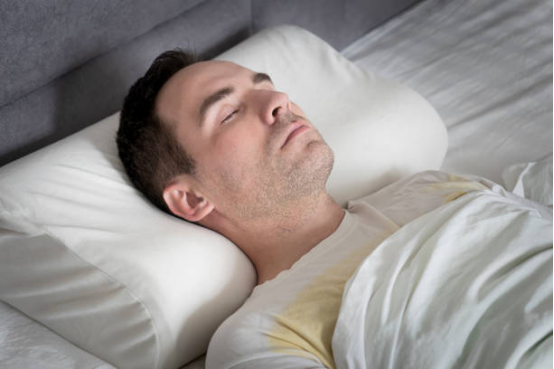
The role of a sleep aid pillow is not to replace but to serve as a transition.
It is important to emphasize that a memory foam pillow is not a medical device, nor should it be described as a “cure for insomnia.” From a professional standpoint, it is more accurately understood as a sleep aid pillow—a form of physical optimization designed to improve comfort and reduce unnecessary bodily stress during rest.
In behavioral sleep medicine, there is a commonly accepted intervention logic: first stabilize bodily sensations, then adjust psychological expectations, and finally change behavior. Within this framework, improving physical support through a memory foam pillow helps establish a more reliable sensory baseline, making subsequent cognitive and behavioral adjustments easier to sustain.
As the body gradually becomes accustomed to the stable and predictable comfort of the bed, the brain’s trust in the “sleep environment” begins to recover. When physical discomfort is no longer sending continuous alert signals, even the process of tapering medication tends to provoke less anxiety and resistance than expected.
Some users have shared similar experiences within sleep health communities:
“At first, I didn’t intentionally reduce my medication, but I noticed that even when I took it a bit later on certain nights, falling asleep wasn’t as difficult as I had imagined.”
This transformation may appear accidental on the surface, but in reality, it reflects a physical change that precedes a psychological one. By quietly improving bodily stability and comfort, a memory foam pillow can help create the conditions in which confidence in natural sleep gradually returns.
Natural sleep improvement often begins with “no longer being disturbed.”
Many articles about natural sleep improvement emphasize meditation, breathing techniques, or structured sleep management routines. These approaches are undoubtedly valuable, but their effectiveness is often limited if the body continues to experience persistent, low-level discomfort. This is where a memory foam pillow becomes relevant early in the conversation, because physical conditions form the foundation upon which all mental relaxation techniques depend.
Imagine this scenario: you have turned off the lights, put away your phone, and slowed your breathing, yet your neck remains subtly suspended and your shoulders feel compressed against the mattress. In such a state, asking the brain to “relax” becomes an additional task rather than a relief. The nervous system continues to receive conflicting signals—calm intent paired with physical strain.
Within the natural sleep pathway, the role of a memory foam pillow is less about inducing drowsiness and more about “clearing away noise.” By conforming more precisely to the contours of the head, neck, and upper back, a memory foam pillow helps reduce the micro-stimuli that often go unnoticed but steadily consume sleep resources throughout the night.
Once these background disturbances are minimized, many sleep-supporting methods that previously seemed ineffective—such as breathing exercises or mindfulness practices—begin to work as intended. In this sense, optimizing physical support with a memory foam pillow does not replace behavioral techniques, but allows them to operate on a quieter, more receptive nervous system.
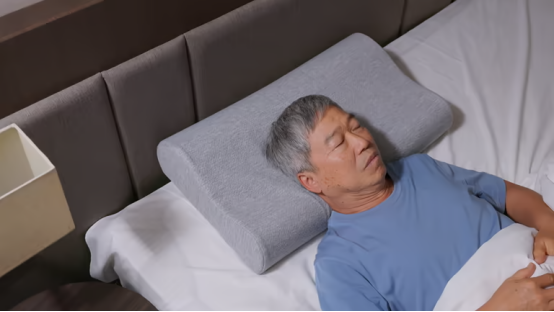
A common change among long-term users: a renewed sense of control over their sleep.
When analyzing user experience, an interesting but consistent phenomenon emerges:
People who rely on sleep aids for a long time often have a strong sense of helplessness regarding sleep; however, this feeling changes when physical comfort improves.
It wasn’t that I stopped taking the medication immediately, nor that I suddenly slept exceptionally well; rather, it was that my fear of the sleep process itself decreased.
The logic behind this is not complicated:
When falling asleep no longer depends entirely on external chemical intervention, or even only partially, people will feel again that “I can participate in the process.”
At this stage, the role of the memory foam pillow has transformed from a simple sleep aid into a stable and predictable point of body support.
It’s not about taking one less pill but about regaining a bit more of your natural sleep instinct.
For those dependent on sleep aids, the real difficulty is never “reducing the dosage,” but rather regaining the belief that the body can fall asleep on its own.
This rebuilding of trust often begins with some very specific, very everyday changes.
A bed.
A pillow.
A feeling of not needing to adjust immediately after lying down.
The Memory Foam Pillow can’t make all the decisions for you, but it can create a condition for you—
allowing your body to relax first, so that sleep no longer depends entirely on the pill’s countdown.
Perhaps the next question will no longer be “Should I take my medicine tonight?”,
but rather, if I don’t take it tonight, will my body be ready?