Will the memory foam pillow change my rolling-over habits?

When we talk about sleep quality, most people focus on “how quickly you fall asleep” or “feeling supported.” However, a long-overlooked truth is that turning over during sleep is not a sign of poor sleep quality but rather a biological instinct for self-protection.
If you recently switched to a memory foam pillow, you might experience a strange sensation—as if you’re “planted” inside the pillow, making it harder to turn over, and even feeling like your sleeping position is forcibly fixed. Is this a manifestation of deep sleep or a constraint imposed by the physical characteristics of the pillow?
We need to delve into the intersection of biomechanics and materials science to deeply analyze how the Memory Foam Pillow is reshaping our sleep movement pillow experience.
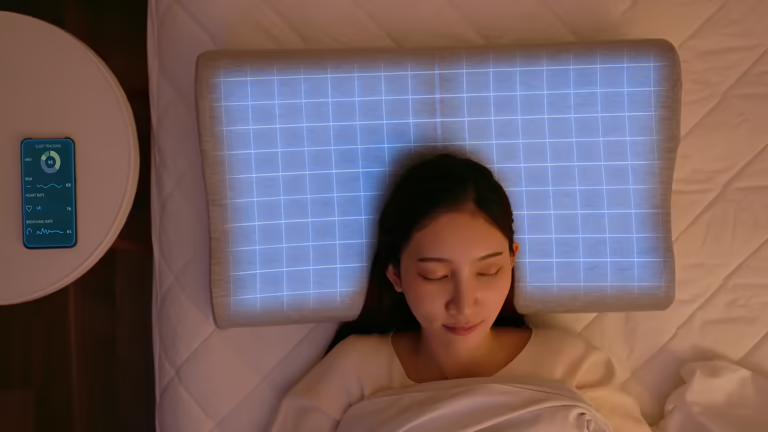
The interplay between viscoelastic materials and dynamic damping
To understand why the memory foam pillow can change your turning during sleep, you first need to break down the core of this material—the viscoelasticity of polyurethane.
Ordinary fiber or down pillows provide a “spring-like” feedback; when you try to turn to your side, the pillow quickly releases compressive energy to assist you in completing the movement. But the memory foam pillow is different; it has extremely high damping properties. When you sink into it, the material absorbs your kinetic energy rather than reflecting it.
The direct consequence of this characteristic is that turning over becomes “heavy.”
Because the memory foam pillow forms a precise contour based on body temperature and pressure, this contour physically creates a tiny “gravity well.” When you try to turn around during sleep, your neck muscles have to overcome greater friction and resistance than on a firm pillow. This shift from “passive rebound” to “active exertion” is the underlying reason why many people perceive their sleeping position as fixed and their number of turns as decreasing.
Is this kind of “passive fixation” good or bad?
In our in-depth observation of the industry, we found that user feedback on sleep movement pillows is often polarized.
For people suffering from neck pain or light sleep, this “passive immobilization” is actually a good thing. Frequent turning during sleep is often caused by uneven pressure distribution leading to decreased local blood flow, forcing the brain to send signals to change position. The Memory Foam Pillow, with its excellent pressure dispersion capabilities, reduces the frequency of the body generating “discomfort signals,” thereby reducing unnecessary movements.
However, for those who are naturally very active sleepers, excessively high or low rebound delay can create a feeling of being trapped. If the memory foam pillow is too dense, it may inhibit normal physiological turning over, leading to muscle stiffness upon waking in the morning.

Quantitative influence of density and temperature sensitivity on the ease of rolling over
Not all memory foam pillows restrict your turning during sleep in the same way. This depends on two key parameters:
Density: High-density pillows offer deeper coverage but also mean stronger energy absorption. If you want a more flexible sleep movement pillow experience while maintaining support, choosing a medium density between 50 and 60 kg/m³ is usually the golden ratio.
Temperature Sensitivity: Traditional memory foam hardens at low temperatures and softens at high temperatures. On winter nights, the unheated edges of the pillow can act like a “wall,” hindering smooth turning. Modern high-end manufacturing processes have begun to optimize non-temperature sensitivity, ensuring consistent turning resistance during sleep at various room temperatures.
If you find your current sleep system makes your neck feel heavy, or if you’re looking for a solution that reduces anxiety when turning over while providing room for adjustment, you might want to learn more about the Memory Foam Pillow.

Breaking Free from the Sense of Being “Sinking”: A New Balance
We must realize that the memory foam pillow is not about eliminating the need for turning over but about optimizing the quality of turning over.
An ideal sleep movement pillow should be like the suspension system of a high-end racing car: providing ultimate fit and stability when stationary but providing the necessary support points when you need to change lanes (turn over).
Rather than saying the Memory Foam Pillow changes your habits, it’s more accurate to say it filters out “ineffective turning over” caused by pain or discomfort. When you no longer toss and turn trying to find a comfortable position, the proportion of deep sleep naturally increases.
FAQ: Frequently Asked Questions about Memory Foam Pillow and Rolling Over
Q1: I have difficulty turning over after using the memory foam pillow. Is it because the pillow is too soft?
On the contrary, this is usually because the material has a slow “rebound speed” (slow rebound property). When you want to turn over, the pillow hasn’t had time to return to its original shape, making you feel like you’re starting on sand. If you really care about this freedom, you can try a memory foam pillow with added gel ingredients or an “open-cell structure,” which usually has a faster response time.
Q2: Will reducing turning during sleep cause a stiff neck?
Normal turning during sleep is to prevent prolonged pressure on local tissues. The memory foam pillow is designed to reduce pressure by increasing the contact area. As long as the pillow’s height (loft) matches your shoulder width and maintains the natural physiological curvature of the cervical spine, reducing the number of times you turn over will not cause a stiff neck; on the contrary, it can reduce muscle strain caused by twisted sleeping posture.
Q3: How can I determine if a memory foam pillow is hindering my normal sleep movement?
Observe your state when you wake up. If you wake up and find yourself in almost the same position as when you fell asleep and feel refreshed, this “fixation” is effective. If you feel stiffness in your neck or even have a headache, it means that the pillow’s damping is too high or its height is incorrect, interfering with your necessary sleep movement and pillow adjustments.