Memory foam pillow optimizes the relaxation of the scapula during sleep.

The quiet of the night, the moment you lie down, should be the most relaxing time of the day. Yet for many people, even with a memory foam pillow beneath their head, the real trouble begins here—back against the bed, but feeling their shoulder blades being “pressed”; turning over, their shoulder and back muscles feel like taut ropes; waking up in the morning not refreshed, but with a stiffness that creeps from the upper back to the neck.
The problem often isn’t “how long to sleep” but “how to be supported.” In particular, the way pressure is managed around the upper back and shoulders is closely related to the choice and structure of a memory foam pillow, which directly influences how the body settles into a resting position.
In discussions of sleep science and ergonomics, the scapular region has long been neglected. Compared to the cervical and lumbar spine, the scapula seems to lack a clear “standard posture.” However, it is precisely this ambiguity that causes many people to feel increasingly tense while sleeping, especially when the pillow fails to adapt to the natural contours of the shoulders and upper back. A well-designed memory foam pillow can respond to body heat and pressure, subtly adjusting its shape to accommodate these variations.
This article will begin by discussing the scapular adsorption mechanism and the tension of the shoulder muscles, dissecting how lateral pressure is redistributed in a lying position, and explaining the crucial role of the memory foam pillow in this process—helping the scapular region truly relax, rather than being passively compressed.
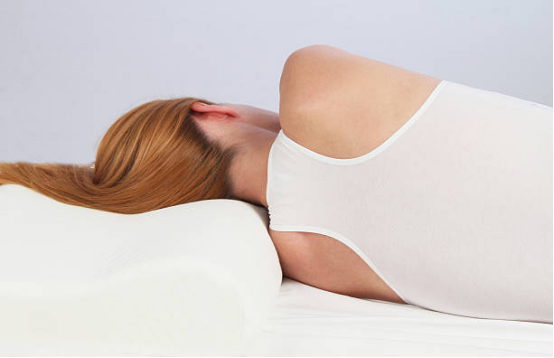
When the shoulder blades cannot “adhere” to the wall, tension begins to accumulate.
Anatomically, the scapula is not directly “fixed” to the skeleton but rather suspended and resting against the back of the thorax by muscle groups. This structure gives Anatomically, the scapula is not directly “fixed” to the skeleton but rather suspended and resting against the back of the thorax by muscle groups. This structure gives the shoulder joint a very high degree of mobility, but the cost is also obvious: stability is highly dependent on the condition of the soft tissues, as well as on the way the body is supported during rest—particularly by the surface of the mattress and the memory foam pillow used at night.
When the scapula cannot naturally fold against the wall, common chain reactions include:
- Long-term compensation of the middle and lower trapezius muscles
- The rhomboid muscles remaining in a stretched state yet unable to fully relax
- The rotator cuff muscles maintaining a form of “defensive contraction,” even during sleep
During the day, these issues may be masked by changes in posture and activity. At night, however, the body is subjected to sustained lateral force, and the problems are amplified. Especially when sleeping on one’s side or in a semi-lateral position, one side of the scapula bears continuous lateral pressure. If the supporting medium—such as a pillow or mattress—is too hard or rebounds too quickly, the pressure is directly concentrated on the acromion and the medial border of the scapula. In contrast, a memory foam pillow, with slower rebound and contouring properties, can help redistribute this pressure rather than reflecting it back into the shoulder.
Many people use a very specific word to describe this feeling: “stuck.”
This is why there has been increasing discussion surrounding the scapula relaxation pillow in recent years—not for providing higher support, but for allowing the shoulder blades room to “sink down,” a function that is closely aligned with the adaptive characteristics of a well-designed memory foam pillow.
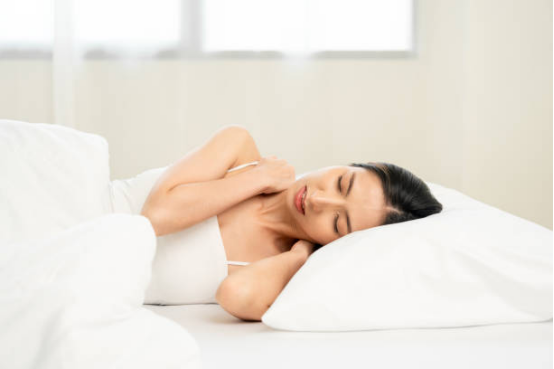
Lateral pressure isn’t the problem; the inability to distribute it is.
Lateral pressure is unavoidable during sleep. What truly differentiates materials is how they respond to this pressure.
The logic behind traditional padding is simple: it’s compressed and rebounds quickly. The problem is that the human body isn’t a regular geometric shape. The inner edge, inferior angle, and acromion of the scapula create multiple stress points with significant elevation differences. If the support material cannot delay its rebound according to changes in shape, the pressure will concentrate in the most prominent areas.
This is precisely the original intention behind introducing memory foam blankets into the sleep system.
In the working mechanism of the memory foam pillow, there are two often overlooked but related characteristics to the degree of scapular relaxation:
- The deformation memory foam in the time dimension
does not rebound instantly, but rather slowly. This “delayed response” means that when the scapula comes into contact with the pillow or the extended area of the mattress, it is not immediately pushed back to its original position but rather undergoes a process of sinking and repositioning. - Multi-point pressure absorption, rather than single-point support, means
That pressure is no longer concentrated at the acromion or medial border of the scapula but is distributed along the upper back contour. This is especially important for people with chronic shoulder tension.
Many users have given interesting feedback after using it for a period of time:
They no longer frequently change position while asleep, and the number of times they turn over is significantly reduced.
This is no coincidence. The body naturally prefers to remain in one position when there are no “alarm signals.”
The key to relaxing your upper back is not just pillow height.
Discussions about pillows have long focused on whether the height is appropriate. However, if we only consider the cervical spine, we easily overlook the synergistic relationship between the upper back and shoulder blades.
In fact, what truly affects upper back comfort is the dynamic balance between neck support and scapular depression.
When the memory foam pillow is designed to align with the shoulder line and upper back curve, it doesn’t just support the head; it participates in the entire upper body pressure system.
This is why the concept of upper back release foam is increasingly being mentioned by professional sleep consultants—release doesn’t mean “softening,” but rather allowing the structure to adapt.
Some sleep studies have shown that in the support system, which possesses memory properties, the electrical activity of the upper back muscles decreases more rapidly in the first 30 minutes after falling asleep, especially for those who work at a desk for long periods. This means that the muscles enter a low-tension state earlier, rather than maintaining superficial tension throughout the night.
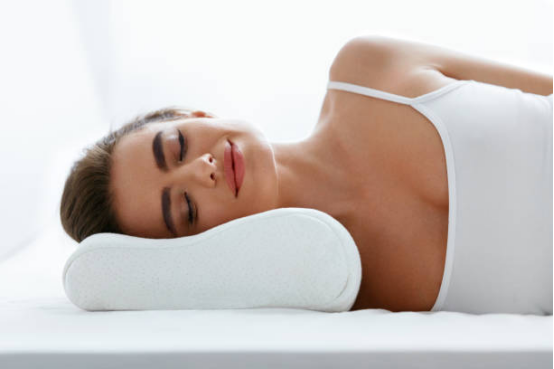
The feeling of “feeling increasingly tense after sleeping” often stems from flawed support logic.
Many people have this experience:
They feel fine on the first night but start to feel discomfort in their shoulders and back a few weeks later.
The problem is usually not in the “adaptation period,” but in the support logic itself.
If the support material only focuses on “holding up” and ignores “releasing,” the scapular area will be repeatedly pushed back to the same unnatural position at night.
In contrast, memory foam slowly returns to its original shape after the pressure is removed, meaning that when you turn over, your body is not “bounced away,” but rather guided to a new balance point.
This experience is difficult to fully perceive in a short trial period, but it gradually becomes apparent with long-term use.
On some sleep forums, some users described their experience as follows:
It’s not that you feel comfortable immediately, but rather that one day you suddenly realize that you no longer need to move your shoulders first thing in the morning.
This is a sign that the scapula has truly relaxed.
From a consumer decision-making perspective, why is the shoulder blade experience gaining importance?
Search behavior reveals a shift in content related to the memory foam pillow from “cervical spine support” to “upper back and shoulder blade experience.”
This is not accidental but rather a result of the refinement of user needs.
In searches with clear commercial intent, people are no longer satisfied with “whether they can sleep” but are concerned with “their physical state after waking up.”
The scapular region, as the hub connecting the neck, arms, and torso, has naturally become a new indicator for assessing sleep quality.
True relaxation happens when you are no longer aware of it.
Comfort during sleep doesn’t always come from obvious “support.”
More often, it’s reflected in the details:
turning over without hesitation;
waking up with no feeling in your shoulders or back;
and your body not needing pain to remind you of what it endured the night before.
When the scapula can naturally adhere to the wall, and when lateral pressure is gently distributed, the Memory Foam Pillow brings not some exaggerated change, but a long-neglected normal state.
Perhaps, the next time you assess your sleep quality, instead of just asking, “How long did you sleep?” you could ask a different question:
Did your body really rest?