The “DIY” possibility of a memory foam pillow: Is it really cost-effective to make your own memory foam pillow?

If you’ve ever unwrapped a memory foam pillow and seen the soft, slightly resilient foam, you might have thought, “Could I make one myself?” With the rise of craftsmanship, environmental awareness, and personalized needs, more and more people are experimenting with DIY lifestyle items, from candles and skin creams to furniture. Memory foam pillows seem to be a new challenge.
But the question is, is the manufacturing process behind this seemingly simple pillow really as easy as imagined?
The “core substance” of memory foam: complexity from materials to formula
First, let’s be clear: memory foam isn’t just any sponge. It’s a polyurethane-based polymer material that achieves its so-called “slow rebound” property by adding additives (such as isocyanates, blowing agents, and catalysts) in varying proportions. The key to this material lies in the balance between density and elasticity.
Making your own usable memory foam requires more than just chemical raw materials; it also requires precise proportion control and temperature management. In actual production, memory foam undergoes multiple stages, including mixing, foaming, aging, cutting, and compression. Each step affects the material’s properties. For example, a slightly lower density will make it loose and collapse; a higher density will result in poor breathability and a hard feel.
Therefore, the biggest difficulty in DIY production is that you may be able to make “foam,” but you may not be able to make “memory foam.”
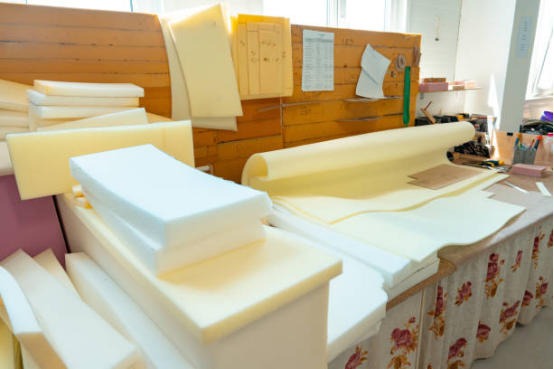
However, there’s a workaround: buying pre-made memory foam blocks. These materials are relatively easy to find online, with prices ranging from $30 to $80 per kilogram. While you can’t completely make your own, you can at least control the shape and appearance. For crafters, this offers a more realistic starting point.
Cost vs. Value: Is DIY Really More Cost-Effective?
Let’s do some simple math. A medium-quality commercial memory foam pillow costs between $40 and $100. If you choose to DIY:
- Memory foam block (1 kg): about $40
- Pillowcase fabric (bamboo or Tencel): $15
- Lining and zipper: $5
- Tools and accessories (scissors, needle and thread, ruler): about $10
The total cost is around $70.
In other words, you might spend more money just for a “handmade experience.”
Of course, this “experience value” isn’t meaningless. The DIY pillow can be customized in shape, firmness, and support. For example, those with cervical discomfort can opt for a higher neck support area; side sleepers can adjust the center thickness of the pillow. For those seeking customization, DIY offers a highly flexible option.
However, if you’re solely considering cost-effectiveness, DIY can’t beat factory-made options. Memory foam pillows on the market are manufactured using large-scale molds and conditioned at constant temperatures, ensuring material stability and durability. While handmade products offer creativity, their performance often falls short.
The real difficulty of manual operation: invisible challenges from cutting to packaging
It seems to be just “cutting a piece of foam and sewing a coat,” but when you actually do it, you will find that problems follow one after another.
First, there’s the issue of cutting.
Memory foam isn’t like ordinary fabric; scissors simply can’t cut it cleanly. Using ordinary knives can easily create uneven cuts and even tear the internal structure. Professional factories use hot wire cutters to ensure smooth cuts, but these devices are expensive and require safety knowledge.
The second challenge is packaging.
Commercially available memory foam pillows often come with a breathable outer shell and inner lining to maintain ventilation and protect against moisture. If DIYers simply wrap the pillow with a single layer of fabric, prolonged use can lead to heat buildup, yellowing, and deformation. This is a detail that many DIYers often overlook.
Finally, there’s another often underestimated step: anti-mite and antibacterial treatment.
Reputable pillow brands typically apply an anti-mite coating to the surface of their memory foam or use natural antibacterial fabrics (such as bamboo charcoal fiber). DIY pillows often lack these steps, and long-term use may cause skin allergies or respiratory discomfort.
In other words, the difficulty of DIY is not “whether it can be done” but “whether it can be used for a long time.”
Creative extension: a more feasible “semi-DIY” path
A new trend is quietly emerging among DIY enthusiasts: the Refoam Project. Instead of creating memory foam from scratch, it recycles old pillows.
For example, many brands of memory foam pillows tend to collapse in the middle after 2–3 years of use, but the edges remain intact. In this case, the still-elastic foam can be cut into smaller pieces and combined with a flexible lining to create a shredded-foam pillow. This not only saves costs but also extends the life of the material.
In addition, some DIY players also mix shredded memory foam with latex scraps and bamboo charcoal particles to create a hybrid pillow with greater support and breathability.
This method is both environmentally friendly and practical—you can experience the sense of accomplishment of DIY while avoiding the complicated chemical process.
So, if you are planning to try to make a memory foam pillow yourself, you might as well start with “renovation” rather than “manufacturing.”
Looking at the future from the perspective of trends: customization, sustainability and user co-creation
In the home furnishings sector, DIY isn’t just a passing fad; it’s the result of a combination of personalized consumption and sustainable design. According to Statista data from 2024, over 28% of consumers expressed a willingness to pay a higher price for customizable sleep products. This is precisely the new trend in the memory foam pillow industry.
Some brands have already sensed an opportunity. Brands like Coop Home Goods have launched height-adjustable shredded memory foam pillows, allowing users to customize the filling to their sleeping position. Emerging brands are developing “DIY modular pillow kits” that users can easily assemble at home, rather than building from scratch. This model, somewhere between “buy” and “DIY,” may be the future.
The value of DIY is more than just saving money. It’s a process of interacting with products and an exploration into redefining “comfort.”
Conclusion
Making your own memory foam pillow may sound romantic, but it’s actually practical. The chemical process involved means you can’t easily replicate factory-quality results, but if you’re willing to experiment with modification, reshaping, or mixing and matching, you can explore another realm of creativity.
Perhaps, the true spirit of DIY is not about “making a perfect pillow,” but that when you adjust the shape of the foam with your own hands, you are also redefining the standard of “good sleep.”