The density secret of memory foam pillows: 40D, 50D, and 60D. Which one is more suitable for you?

Have you ever woken up in the middle of the night to find your pillow deflated like a sponge? Or perhaps your neck is as stiff as a steel rod when you wake up in the morning? Many people buy memory foam pillows, but they don’t realize that density is the key factor in determining comfort and support. What do the commonly seen densities of 40D, 50D, and 60D on the market actually represent? And how can you choose the one that’s best for you?
This isn’t just a question of “soft” or “hard,” but a comprehensive consideration of body support, sleep quality, and long-term health. Today, we’ll break down this seemingly boring numbers game into a simple, easy-to-understand sleep guide.

Why is density so important for memory foam pillows?
Many people’s first reaction is “the higher the density, the better,” but the truth is more complex. Density (D represents kilograms per cubic meter) determines the structural tightness of the foam, which directly affects the support and lifespan of the pillow.
40D: Lightweight and soft, with a fast rebound speed, it is suitable for people who like to “nest in.” Just like when you lie on a sofa cushion, you feel the enveloping feeling instantly, but it may lack stable support for a long time.
50D: A balanced model that offers both support and comfort and is considered a “universal” choice. Whether you sleep on your back or side, you’ll find good support.
60D: High density, firmer texture, slow rebound, and strong support. It is very suitable for people with cervical spine problems who need stable support, but some people find it too hard and not “gentle” enough.
A user who suffers from chronic cervical discomfort shared on a forum that after switching from a regular pillow to a 60D memory foam pillow, her morning stiffness has been significantly reduced. However, her husband prefers a 50D because the 60D is too “rigid” for him. This is a classic example of differentiated experience.
What groups of people are suitable for different densities?
Density is not just a number; it corresponds to different sleeping habits and physical conditions.
1. People who prefer a soft touch
If you often take naps on the sofa or like the feeling of “sinking into the bottom,” 40D may be the best choice. It gives a gentle wrapping feeling, but if you are heavier, you may feel that the support is insufficient.
2. For those who want a versatile pillow
50D is the ideal density for most regular users. It adapts to different sleeping positions without being too firm or collapsing too quickly. Like a classic pair of jeans, it can fit almost anyone.
3. If you have a history of cervical spondylosis
If your doctor recommends that you maintain a stable neck, 60D may be a more reliable choice. Although it may feel stiff at first, it will provide better support in the long run.
Tips: Heavier people are more suitable for high-density pillows because low-density pillows are easily compressed too low; while lighter people can enjoy the softness of 40D or 50D.
Real experience and industry trends
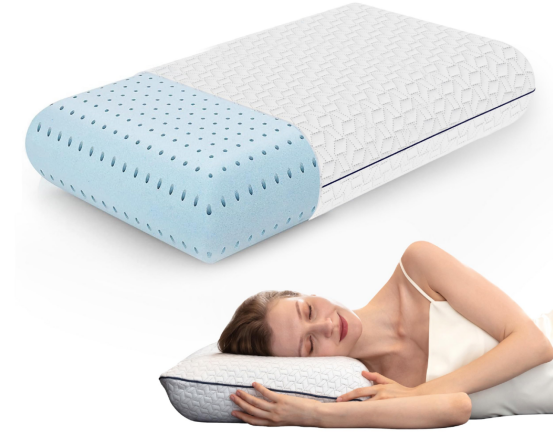
In the past, memory foam pillows were often criticized for being “too hot in the summer.” However, in recent years, many brands have improved heat dissipation by adding ventilation holes or cooling gels to the high-density materials. This means that even high-density versions like 60D are no longer equivalent to “sleeping on a hot brick.”
One US user wrote in an Amazon review, “I was initially worried that the 60D would be too firm, but because this one has cooling gel, it actually allows me to sleep cooler in the Texas summer.”
Judging from industry trends, demand for medium- and high-density pillows is rising, especially 50D and 60D, as they have advantages in lifespan and support. In other words, consumers are gradually shifting from “soft” to “healthy support” options.
How to choose the one that belongs to you?
Choosing a pillow is like choosing shoes; there’s no perfect answer. You need to consider the following aspects:
Sleeping position
Back sleeping: 50D is more stable, supporting the neck without being too high.
Side sleeping: You can consider 60D to avoid the “hanging feeling” between the shoulders and neck.
Sleeping on your stomach: 40D is more suitable because it is soft enough and will not over-elevate the cervical spine.
Climate and environment
If you live in a hot and humid area, remember to choose a version with ventilation holes.
In cold areas, high density can give you a stable and warm experience.
Budget and lifespan
40D: Relatively cheap, but may need to be replaced more often.
50D: Moderately priced, with a lifespan of 3-5 years.
60D: More expensive, but more durable, often lasting more than 5 years.
How much density do you really need?
When choosing a memory foam pillow, look beyond the “super soft” or “super support” advertised. The real key is density.
Want lightness and softness? 40D.
Want a balanced, versatile camera? The 50D.
Want solid health? 60D.
The ultimate answer is not “which one is best” but “which one is best for you.” Your weight, sleeping position, environment, and health status are the determining factors.
If you are still hesitant, you might as well ask yourself: What do you need more? Short-term comfort or long-term health?
Maybe next time you wake up, you won’t wake up with a stiff neck, but a relaxed and comfortable one. After all, a small pillow can quietly determine your daily state. So, would you choose 40D, 50D, or 60D?